 The science of spirituality
From a video by ThinQ
Dr. Lisa Miller, a Professor at Columbia University, a psychologist and New York Times bestselling author, explores the intersection of science and spirituality, particularly focusing on how a deep spiritual connection can serve as an antidote to the rising tide of despair, suicide, and mental health issues among young people aged 18–25. Lisa’s talk is grounded in both scientific research and personal conviction, advocating for the integration of faith and science in understanding human wellbeing.
She begins by highlighting a disturbing trend: nearly half of young adults in the 18–25 age group in USA suffer from what she calls “diseases of despair,” including addiction, depression, and suicide. She argues that these issues can no longer be viewed solely as individual problems but must be understood as symptoms of a broader cultural crisis. This crisis is characterised by “radical materialism” (the belief that only tangible things are real) and “radical anthropocentrism” (an overemphasis on human power and achievement). These cultural forces, she contends, are “swallowing up our youth” and contributing to widespread suffering.
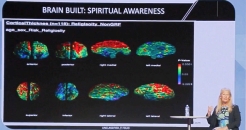
Lisa then presents scientific evidence to support the idea that humans are inherently spiritual beings. She references research published in the Journal of the American Medical Association, which shows that every person is born with a brain that is naturally receptive to a relationship with God and to spiritual experiences. According to her findings, spiritual awareness is “one-third innate and two-thirds cultivated.” This means that while everyone has a natural capacity for spirituality, it is largely shaped by family, community, and religious practices.
"Every one of us, all 7.2 billion people on Earth, is born from day one with a brain ready for a direct relationship with God. MRI scans of brains over time show that whether it is through reading scripture, through prayer, through fellowship, we cultivate this because of the gift of our innate, natural, spiritual awareness. It is 1/3 innate and two thirds cultivated. Cultivated at the family table, in the community, in service and in practices."
One of the most compelling aspects of Lisa's argument is the protective effect of spirituality against mental health challenges. She cites studies showing that individuals with a strong spiritual life are significantly less likely to suffer from addiction or engage in risky behaviours. For example, a deep connection to God is associated with an 80% reduction in the risk of addiction and a 70% reduction in dangerous risk-taking. Most strikingly, she notes that a spiritually rich religious life, especially when shared in fellowship and family, is linked to an 82% decreased risk of completed suicide among young people. Lisa asserts that there is nothing in clinical or social sciences as profoundly protective as spirituality against an epidemic of suicide in Generation Z.
She reframes suffering not as a purely negative experience but as a “knock at the door” to spiritual awakening. She explains that many people develop a deeper relationship with God through adversity, loss, or disappointment. While some may experience spontaneous spiritual awakenings, for most, it is the “road of trials” that leads to the strengthening of their spiritual core. This process, she argues, is essential for building resilience and a sense of purpose.
Throughout her talk, Lisa emphasises the importance of community, family, and religious fellowship in cultivating spirituality. She describes spirituality as both a personal and communal journey, where individuals are called to love, guide, and support one another. She also identifies three key life stages—emerging adulthood, midlife, and elderhood—where people have opportunities to deepen their spiritual awareness, each time requiring the support of a faith community.
"There are three bridges. The first, in emerging adulthood, the second, as we cross the bridge to midlife and the third as we rise to elderhood. At at each time, we expand in our capacity to feel God's presence. We become more aware of our birth right, and yet, each time, we need the riches of a faith community, of religious guidance."
Lisa concludes by urging her audience to recognise their unique position in addressing the cultural crisis of despair. Who else do we need? She calls on everyone to use their love for God and each other to share their faith.
Watch this 12 minute video here.
Retweet about this article:
From a video by ThinQ, 13/01/2026