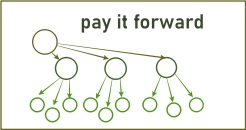
 Funding non-profits - the pay-it-forward framework
From an article on Stanford Social Innovation Review
What does it take for a non-profit to grow without external support?
Non-profits can grow without ongoing external funding if their impact “reproduces” through the people they serve - similar to how an epidemic spreads only when its reproduction rate 𝑅0 is greater than 1. During the COVID-19 pandemic, 𝑅0 became widely understood as a threshold concept: if each case produces more than one additional case, the system becomes self-sustaining; if not, it gradually fades unless continuously supported from the outside. Does a comparable structural distinction exists in the non-profit world?
Most non-profits operate on a consumptive model: they raise money, deliver services, and if funding stops, the activity stops. But some organisations contain a transmissive dynamic, where beneficiaries become contributors who extend the organization’s reach, reducing the need for proportional increases in paid staff or fundraising.
The article gives several transmissive examples:
Alcoholics Anonymous (AA) — “Therapeutic transmission.”
AA scaled from two founders (1935) to over two million members without centralised leadership or external funding. The mechanism is that “stabilised” members help newcomers partly because helping reinforces their own sobriety. Lesson: pay-it-forward is strongest when contributing is built into maintaining the original benefit, not added as extra altruism.
Rotary International — “Role-embedded social transmission.”
Rotary grew from 12 members (1905) to 108,000+ (1925), which is a high transmission rate (about 𝑅≈1.58 per year). Recruiting was a natural extension of membership because the club delivered valuable social/professional benefits and a replicable chapter structure. Rotary also illustrates fragility: when the social role of business clubs weakened (networking moved elsewhere; civic habits changed), growth slowed. Lesson: social transmission can drive growth, but it needs ongoing maintenance of the value proposition.
Habitat for Humanity — “Contractual transmission.”
Habitat links receiving the benefit (affordable homeownership) to helping produce it through “sweat equity,” where prospective homeowners help build homes (including for others). Lesson: when the benefit is tangible and the pathway is clear, reciprocity can be designed as a condition of access rather than hoped for later.
Big Brothers Big Sisters — “Depth over transmission.”
The model relies on careful screening and long-term one-to-one mentoring, making rapid replication harder. Lesson: some programs are quality-constrained; pushing for transmission/scale can undermine effectiveness, so low transmission can be the right design choice.
However, there are domains where transmission is inappropriate. Areas like emergency response (e.g., water distribution after an earthquake), pure redistribution (food, shelter, legal protection), and collective-action/institutional reforms (air quality, anti-corruption, wetlands preservation, procurement rules). Lesson: low transmission here reflects the nature of the work, not weak design - these efforts often legitimately require ongoing funding and institutional capacity.
The article warns that treating “sustainability” as a universal benchmark leads to two opposite errors:
-
Continuing to subsidise programs that could be redesigned to generate some self-renewing growth
-
Demanding self-sufficiency from organisations whose work is inherently dependent on ongoing resources and should not be judged by whether it can pay for itself.
Therefore the article proposes a Pay-It-Forward Threshold to help leaders and funders distinguish between these choices and design or evaluate programs more appropriately. The Pay-It-Forward Threshold is a way to tell whether a non-profit’s impact is inherently funding-dependent or whether it has the potential to become self-renewing because beneficiaries start helping bring in and support new beneficiaries.
Key to this is the metric: “transmission rate”. The framework proposes measuring a transmission rate which is the average number of new people each former participant helps reach/recruit/support. This is analogous to 𝑅0 in epidemiology, but applied to social programs.
If the transmission rate rises above 1, the organisation crosses the Pay-It-Forward Threshold: each “generation” of participants produces more than one new participant on average, so growth can become self-sustaining.
Here is an example. If a job-readiness program has:
Cycle 1: 1000 participants complete
Cycle 2: 1500 participants complete
Growth = 500.
Directors should ask, "How many of those 500 came because alumni helped?" If 300 entered due to alumni referrals / mentoring / onboarding help, then: participant transmission = 300/1000=0.3, meaning 30% of growth is coming through participants rather than paid outreach.
How does this change approaches?
Leaders: shift from “How do we recruit more people?” to “Under what conditions do participants become contributors?” Then design concrete pathways (peer roles, handoffs, referral routes, early low-commitment contributions, etc.).
Funders/policymakers: don’t apply one “sustainability” standard to everything. Consumptive programs should be judged on cost-effectiveness and outcomes; transmissive programs should also be judged on whether they’re building renewal capacity over time.
Read the full article here.
Retweet about this article:
From an article on Stanford Social Innovation Revi, 24/06/2026