 Weekend schools for disadvantaged children
From material by IMC Weekend School
IMC Weekend School is a supplementary school for 10-to-14-year-olds from under-resourced neighbourhoods - areas with lower average incomes, higher poverty rates, and fewer opportunities for enrichment outside regular school. Over a three-year programme, professionals introduce children to fields such as journalism, medicine, law, philosophy, the arts, astronomy, and entrepreneurship.
Since 1998, they have been creating opportunities for young people in places where it is most needed.
The concept originated from psychologist, Heleen Terwijn, who observed that ten-year-olds are fully occupied with fantasies about their future. That curiosity is only partly nurtured at school, while children are all, by nature, broadly interested. During her research, Heleen developed the idea of bringing children from the receptive age of ten into contact with enthusiastic professionals and interesting fields.
This has now crystalised under the educational concept, 'Future Expedition'. Every week, they help create futures at weekend schools and primary schools throughout the Netherlands. The aims are; broadening future perspectives, strengthening self-confidence, stimulating social connection, training life skills and encouraging motivation to continue to develop.
The curriculum opens up a wide range of worlds, with subjects such as: Medicine, Law, Entrepreneurship, Philosophy, Visual Arts, Journalism and Politics.
Every young person has an unpolished desire to be someone in the world. Future Expedition feeds that desire as richly as possible by allowing young people to participate in the world, to cultivate courage, to gain wisdom in life and to make mistakes. In this way, the programme creates the conditions under which young people develop broadly social-emotionally and focus their intrinsic motivation step by step.
They offer multi-year, long-term stimulating education to young people in various programs. Upon completion, the alumni network provides guidance, support and career guidance and, above all, the invitation to alumni to dedicate themselves in turn to the new generations.
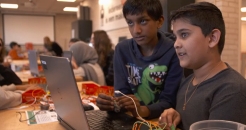
The guest lecturers take the students into real-life situations. For example, the students learn to diagnose with a general practitioner, program with an IT specialist, extinguish fires with the fire brigade, debate with an alderman, make judgments with a judge and make reports with a journalist.
The educational concept is already often scientifically substantiated. The effects of the programme are continuously investigated in collaboration with universities, colleges and research agencies, including the University of Amsterdam, Amsterdam University of Applied Sciences, the Vrije Universiteit Brussel.
The approach has been received with great enthusiasm both inside and outside their network. In the Netherlands, there are many spin-offs. Internationally, they have helped social entrepreneurs within and outside Europe to set up sister schools.
Visit their website (use translate option).
Retweet about this article:
From material by IMC Weekend School, 15/07/2026