 “What about me?” - Part 1
From an article by Together for the Common Good
Captain John Clifton is a Salvation Army officer, ordained minister, and theologian based in North East England. His work emphasises the church’s engagement in public life and society, particularly supporting communities affected by debt, hunger, homelessness, and unemployment. He challenges the prevailing culture of professionalised Christian charity. He also asks searching questions of class, recognition, and moral location, exploring what the gospel offers those who have been marginalised by mainstream societies.
He spoke to Salvation Army European colleagues at a conference in Rome, challenging them to consider whether their public witness is disclosing Christ or merely protecting respectability.
This summary of his talk is in two parts. A link to the second part is provided at the end.
Part 1: The Lost Sheep, the Limits of Charity, and the Question “What About Me?”
John begins by telling a story from his time with the Salvation Army in East London. He helped develop Project Malachi, a housing project for people who were homeless and had no recourse to public funds. These were people who, because of their immigration status, could not get help from the usual welfare system.
The project was a good and important one. It grew out of years of local work, strong relationships, and support from many parts of the community. Its name came from a young boy called Malachi, who gave five pounds from the tooth fairy and asked the Salvation Army to build homes for people who were homeless. That small gift helped inspire a project worth millions of pounds.
The project had a powerful story behind it. The new accommodation was being built on land linked to the early Salvation Army in that town. The site had also once been used by a funeral director, so people spoke about it as a sign of resurrection: a place connected with death becoming a place of life. The project brought together Christians, Muslims, Sikhs, politicians, community workers, and local people. It received media attention and was rightly celebrated.
But, in the middle of this success, there was one man the project could not help.
This man had once been a taxi driver. After a relationship breakdown and other difficulties, he became homeless and isolated. Because of his situation, he did not qualify for the new accommodation. John remembers him asking,
“This isn’t going to help me, is it. What about me?”
John says this was the sort of question that
“should stop you in your tracks.” But he admits that, at the time, it did not stop him enough. The project was moving forward, the funding was in place, and the story was working. Yet this one man was standing in front of him, still outside the help being offered.
John is honest about the man’s behaviour. He was not easy to help. He could be angry, disruptive, racist, and misogynistic. He does not pretend that poverty automatically makes people good or gentle. He comments that
“while absolute power corrupts absolutely, so too does absolute powerlessness.” In other words, being powerless can damage people deeply.
Eventually, the man was asked to leave the night shelter, and John lost touch with him. Later, during the COVID-19 lockdowns, he saw him again on the street. The man looked exhausted, alone, and changed. John did not approach him. He was afraid and felt ashamed because he no longer knew what he could offer.
This memory becomes the heart of John’s argument. Project Malachi helped many people, but it did not help everyone. He says that
“institutional narratives can unintentionally produce blindness.” A good organisation can tell a strong story, raise money, build support, and do real good, but still fail to see the person left outside. The man’s question, “What about me?”, becomes more than one person’s complaint. It becomes a question for the Salvation Army and for the Church: who is being missed, even when our work looks successful?
John then connects this story with Matthew 25, where Jesus says that what people do for the hungry, thirsty, stranger, sick, naked, or imprisoned, they do for him:
“just as you did it to one of the least of these brothers and sisters of mine, you did it to me.” He asks whether Christ was any less present in the one homeless man than in the many people the project helped:
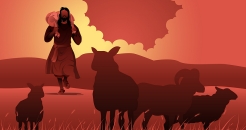
“Was Christ any less present amongst that one lost sheep of a man, than the 99 who we were able to help?” This is a hard question. It asks whether Christian service is only about running good projects, or whether it is also about recognising Christ in the difficult person in front of us.
John widens the point to Europe today. Many people feel ignored, unheard, or left behind. They may feel that institutions talk about them but do not know them. The question
“Whose side are you on?” is not just a political slogan. For John, it is really about trust, belonging, and whether people feel seen. He says the Salvation Army cannot stand outside these questions.
“We are not neutral observers of Europe’s fractures. We are located somewhere within them.” Christianity is not only a set of beliefs to be spoken; it is “a presence to be embodied.”
So this part 1 of the talk is a warning:
successful Christian work can still miss people. The Church must stay close enough to real people to hear the question, “What about me?”
Read Part 2 - Reading the Times, Staying Close, and Telling Better Stories here.
Read the full Together for the Common Good article here.
Watch the 56 min talk here:
Retweet about this article:
From an article by Together for the Common Good, 22/09/2026